

Vietnam Entry Visa for Chinese Citizens 2026: Latest Entry Regulations and E-Visa Guide
Vietnam has become one of the most attractive destinations in Southeast Asia for Chinese travelers, business visitors, investors, family visitors, and transit passengers. With convenient flight routes from major Chinese cities to Hanoi, Ho Chi Minh City, Da Nang, Nha Trang, Phu Quoc, and other destinations, more Chinese citizens are planning short holidays, business meetings, trade visits, family trips, and long-stay travel in Vietnam.
However, before entering Vietnam, Chinese passport holders should carefully check the latest Vietnam entry visa regulations. In most cases, Chinese citizens are required to obtain a valid Vietnam visa before arrival, unless they fall under a specific visa exemption category or special entry arrangement. The most common and convenient option today is the Vietnam electronic visa, also known as the Vietnam e-visa.
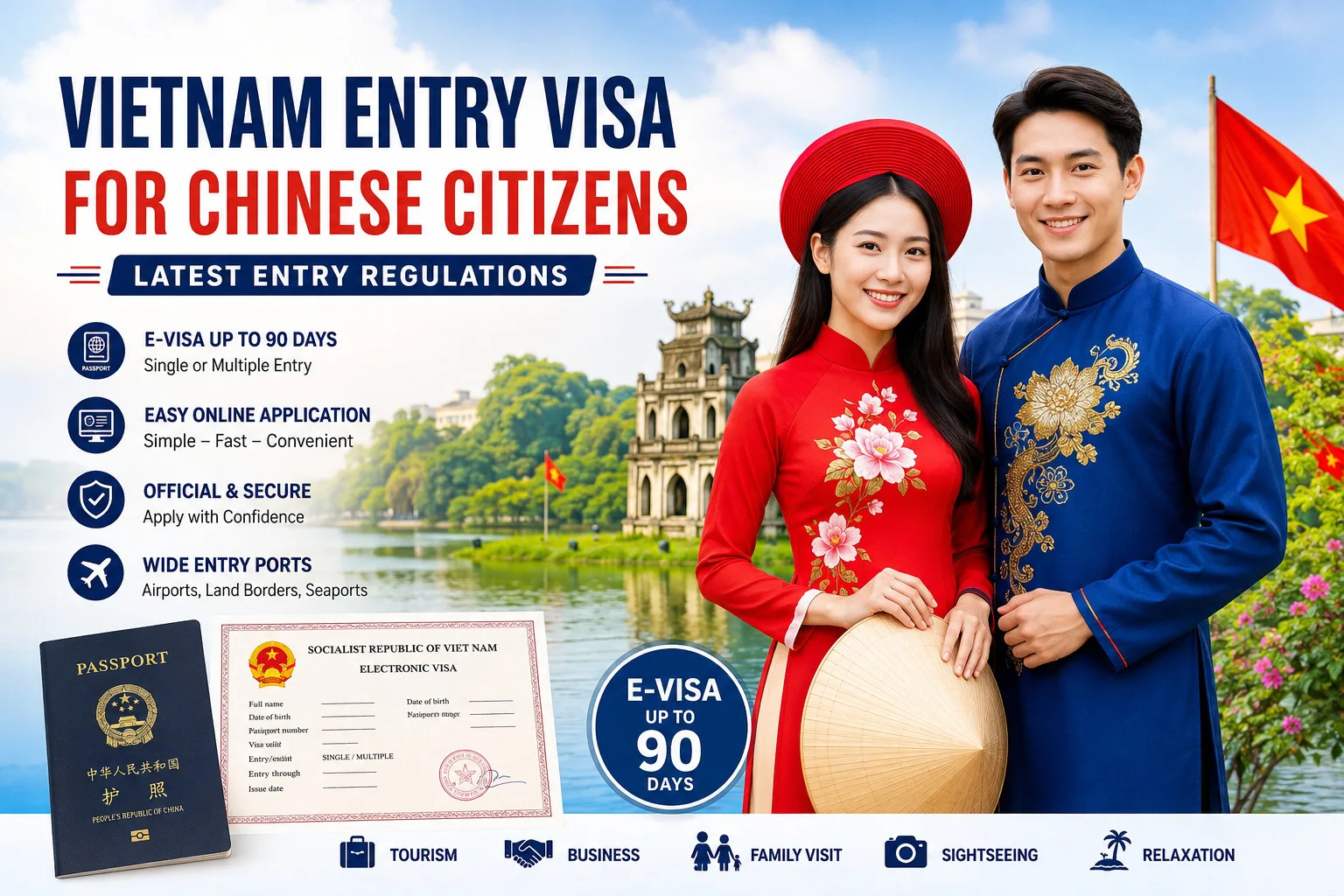
The Vietnam e-visa system allows eligible foreign passport holders, including Chinese citizens, to apply online without visiting a Vietnamese embassy or consulate. The current Vietnam e-visa can be valid for up to 90 days and may be issued for single entry or multiple entries, depending on the applicant’s travel plan and approved visa type. This makes the e-visa suitable for tourism, business meetings, family visits, short-term work preparation, conferences, market research, and other lawful entry purposes.
This complete guide explains the latest Vietnam entry visa regulations for Chinese citizens, including who needs a visa, how to apply for a Vietnam e-visa, required documents, processing time, visa fees, entry conditions, common mistakes, urgent application notes, and practical travel tips before entering Vietnam.
Do Chinese Citizens Need a Visa to Enter Vietnam?
Yes. In general, Chinese citizens holding ordinary Chinese passports need a valid visa to enter Vietnam. The visa should be obtained before traveling, unless the traveler is eligible for a specific visa exemption policy, diplomatic arrangement, or other lawful entry category.
For most Chinese tourists and business visitors, the Vietnam e-visa is currently the most practical option. It is applied for online, does not require sending the physical passport, and can be used at approved international airports, land border gates, and seaports in Vietnam.
Chinese citizens should not assume that they can receive a visa automatically upon arrival at the airport. Vietnam’s visa-on-arrival arrangement is not the same as the old airport visa model used by some countries. In many cases, travelers who plan to use visa-on-arrival must have a valid approval letter before boarding the flight. For ordinary tourism and short business trips, the e-visa is usually simpler, clearer, and more suitable.
Before departure, Chinese travelers should make sure that:
- Their passport is valid for the required period.
- Their visa information exactly matches the passport.
- Their entry date is within the approved visa validity.
- Their intended entry port is allowed under the visa.
- They have printed or saved a copy of the approved e-visa.
- Their travel purpose is consistent with the visa type and entry regulations.
Airlines may deny boarding if the traveler does not have a valid visa or if the visa details do not match the passport. Immigration officers in Vietnam may also refuse entry if the traveler fails to meet entry conditions.
Latest Vietnam E-Visa Policy for Chinese Citizens
Vietnam’s electronic visa policy has become more flexible in recent years. The e-visa is now one of the most important visa channels for foreign visitors entering Vietnam. According to official information from Vietnam’s electronic visa system, the Vietnam e-visa may be valid for a maximum of 90 days and can be issued for single or multiple entries.
For Chinese citizens, this means that the e-visa can support different travel needs:
- A short holiday in Vietnam.
- A business meeting or trade visit.
- A family visit.
- A conference or exhibition trip.
- A multi-city Vietnam itinerary.
- A trip that includes leaving and re-entering Vietnam.
- A longer stay of up to 90 days, if approved.
The multiple-entry e-visa is especially useful for Chinese travelers who plan to combine Vietnam with nearby destinations such as Thailand, Cambodia, Laos, Singapore, Malaysia, or other countries in the region. Instead of applying for a new visa after leaving Vietnam, a multiple-entry e-visa allows the traveler to enter Vietnam more than once during the approved validity period.
However, travelers should remember that the e-visa validity period is not automatically the same as the intended stay. The exact validity dates are printed on the approved visa. Chinese citizens must enter and exit Vietnam within the approved visa period. Overstaying can lead to fines, administrative procedures, travel delays, and possible difficulties with future visa applications.
Best Vietnam Visa Type for Chinese Citizens
The best Vietnam visa type depends on the purpose of travel, length of stay, number of entries, and urgency of the trip. For most Chinese passport holders, the Vietnam e-visa is the recommended option because it is online, transparent, and widely accepted at many official entry ports.
Vietnam Tourist E-Visa for Chinese Citizens
A tourist e-visa is suitable for Chinese citizens visiting Vietnam for leisure, sightseeing, beach holidays, food tours, cultural trips, or family vacations. Popular destinations include Hanoi, Ha Long Bay, Ninh Binh, Da Nang, Hoi An, Nha Trang, Da Lat, Ho Chi Minh City, Mekong Delta, and Phu Quoc.
Chinese tourists should apply early, especially during peak travel seasons such as Chinese New Year, summer holidays, National Day holiday, and year-end travel periods. Processing delays may happen if the application contains errors or if the system receives a high number of applications.
Vietnam Business E-Visa for Chinese Citizens
A business e-visa may be suitable for Chinese citizens attending meetings, exploring business opportunities, visiting partners, joining trade fairs, or conducting short-term commercial activities permitted under Vietnamese regulations.
For longer work, employment, investment, or residence purposes, travelers may need a different visa category, sponsorship, work permit, temporary residence card, or other legal documents. The e-visa should not be used for activities that require a separate work authorization.
Vietnam Multiple-Entry E-Visa for Chinese Citizens
A multiple-entry e-visa is suitable for travelers who need to enter Vietnam more than once during the visa validity period. For example, a Chinese business visitor may enter Vietnam for meetings in Hanoi, travel to another country for a few days, and then return to Ho Chi Minh City for another meeting.
A multiple-entry visa is also useful for tourists planning a Southeast Asia itinerary with Vietnam as the first and final destination.
Embassy or Consulate Visa
Some travelers may still choose to apply through a Vietnamese embassy or consulate, especially if they need a visa type that is not suitable for the e-visa system. This option may be relevant for special purposes, long-term stays, diplomatic passports, official passports, or cases requiring additional documentation.
Sponsored Visa or Approval-Based Visa
For employment, long-term business, investment, study, or family-related purposes, Chinese citizens may need a sponsoring company, organization, or relative in Vietnam. In these cases, the sponsor may need to prepare documents with the competent Vietnamese authority before the traveler can receive the correct visa.
Vietnam E-Visa Validity for Chinese Passport Holders
The Vietnam e-visa can be valid for up to 90 days. It may be issued as either:
- Single-entry e-visa.
- Multiple-entry e-visa.
A single-entry e-visa allows the traveler to enter Vietnam once. After leaving Vietnam, the visa is no longer valid for another entry, even if the visa validity period has not expired.
A multiple-entry e-visa allows the traveler to enter and exit Vietnam multiple times during the approved visa validity period. This option is more flexible for business visitors, regional travelers, and tourists with multi-country itineraries.
Chinese citizens should carefully check the following information on the approved e-visa:
- Full name.
- Date of birth.
- Nationality.
- Passport number.
- Passport expiry date.
- Visa validity dates.
- Single-entry or multiple-entry status.
- Entry and exit conditions.
- Any remarks or special notes.
Even a small mistake in passport number, name spelling, date of birth, or nationality may cause problems at check-in or immigration. If an error is found, the traveler should correct it before departure instead of waiting until arrival.
Vietnam E-Visa Fees for Chinese Citizens
The official e-visa fee depends on whether the applicant applies for a single-entry or multiple-entry e-visa. The commonly listed government fee is 25 USD for a single-entry electronic visa and 50 USD for a multiple-entry electronic visa.
In practice, applicants should always check the latest fee directly on the official payment page at the time of application because government fees, payment methods, and processing rules may change. The visa fee is usually non-refundable if the application is refused, cancelled, submitted incorrectly, or not used.
If Chinese citizens apply through a service agency, they may pay an additional service fee. This service fee is separate from the government fee and may vary depending on urgency, support level, document checking, translation assistance, or correction support.
Vietnam E-Visa Processing Time for Chinese Citizens
The standard Vietnam e-visa processing time is commonly around 3 working days after successful submission and payment. However, this timeframe is not guaranteed in every case. Applications may take longer if:
- The uploaded passport image is unclear.
- The portrait photo does not meet requirements.
- The passport information is entered incorrectly.
- The applicant chooses the wrong nationality.
- The travel dates are inconsistent.
- The application requires additional review.
- The submission is made before weekends or public holidays.
- The system is overloaded during peak seasons.
- The applicant applies too close to the departure date.
Chinese citizens are strongly advised to apply at least 7 to 10 working days before departure. For peak travel periods, applying even earlier is safer. Travelers should not book non-refundable flights or hotels without allowing enough time for visa processing.
If the trip is urgent, the traveler should prepare all documents carefully and consider professional support to reduce avoidable mistakes. However, no service provider can guarantee approval because the final decision belongs to the competent Vietnamese authority.
Vietnam Entry Requirements for Chinese Citizens
Having a visa does not automatically guarantee entry. Chinese citizens must also satisfy Vietnam’s general entry conditions. At the border, immigration officers may check the traveler’s documents and purpose of entry.
Common entry requirements include:
- A valid Chinese passport.
- A valid Vietnam visa or e-visa.
- Passport validity that meets airline and immigration requirements.
- A printed or digital copy of the approved e-visa.
- Travel itinerary or accommodation information if requested.
- Return or onward ticket if requested by airline or immigration.
- Compliance with Vietnamese laws and entry conditions.
- No entry ban, security restriction, or immigration violation record.
Travelers should make sure that the passport used for the visa application is the same passport used for travel. If the traveler renews the passport after receiving the e-visa, the old e-visa may no longer match the new passport. In that case, a new visa may be required.
Required Documents for Vietnam E-Visa Application
Chinese citizens should prepare the following documents before applying for a Vietnam e-visa:
Valid Chinese Passport
The passport should be valid and in good condition. The passport information page must be clear, complete, and readable. The passport number, full name, date of birth, sex, nationality, and expiry date must match the application form exactly.
Passport Data Page Image
Applicants need to upload a photo or scan of the passport data page. The image should not be blurry, cropped, shadowed, or covered by glare. All passport details must be visible.
Portrait Photo
Applicants need a recent portrait photo looking straight at the camera, usually without glasses. The background should be plain, and the face should be clearly visible.
Travel Information
Applicants should prepare:
- Intended date of entry.
- Intended date of exit.
- Entry port.
- Exit port.
- Address in Vietnam.
- Purpose of entry.
- Contact information.
Payment Card
A valid international payment card may be required to pay the e-visa fee online. Applicants should ensure that the card supports international online payments.
Email Address
The applicant should use an email address that can be accessed easily. The registration code and application updates may be needed to check the visa result.
How Chinese Citizens Can Apply for a Vietnam E-Visa Online
The Vietnam e-visa application process is straightforward, but accuracy is very important. A small mistake may delay the application or make the visa unusable.
Step 1: Prepare Passport and Photo Files
Before starting the application, prepare a clear passport data page image and a proper portrait photo. Make sure the files meet the required format and size.
Step 2: Complete the Online Application Form
Enter personal information exactly as shown in the passport. Do not translate the name into another format. Do not omit middle names if they appear on the passport.
Important fields include:
- Full name.
- Sex.
- Date of birth.
- Nationality.
- Passport number.
- Passport type.
- Passport issue date.
- Passport expiry date.
- Religion, occupation, or other requested information.
- Contact details.
- Travel dates.
- Entry and exit ports.
- Address in Vietnam.
Step 3: Upload Required Images
Upload the passport data page and portrait photo. Check that both images are clear before continuing.
Step 4: Review All Information Carefully
Before payment, review every detail. Chinese citizens should pay special attention to:
- Passport number.
- Full name order.
- Date of birth.
- Nationality.
- Visa validity dates.
- Entry port.
- Email address.
Step 5: Pay the E-Visa Fee
After submitting the application, pay the visa fee online. The application is normally processed only after successful payment.
Step 6: Save the Registration Code
The system may provide a registration code. Save this code carefully because it is needed to check the result.
Step 7: Check the Visa Result
After the processing period, use the registration code, email, and date of birth to check the application status.
Step 8: Download and Print the E-Visa
Once approved, download the e-visa PDF and print at least one copy. It is also wise to save a digital copy on the phone and email.
Common Mistakes Chinese Citizens Should Avoid
Many Vietnam e-visa problems are caused by simple mistakes. Chinese travelers should avoid the following errors:
Entering the Wrong Passport Number
A wrong passport number can make the visa invalid for travel. Always copy the passport number exactly.
Choosing the Wrong Nationality
Applicants should select the correct nationality according to the passport used for travel.
Uploading a Blurry Passport Image
If the passport image is unclear, the application may be delayed or rejected.
Using an Incorrect Portrait Photo
Photos with sunglasses, hats, heavy shadows, filters, or side angles may not be accepted.
Applying Too Late
Applying one or two days before departure is risky. Processing may take longer than expected.
Confusing Single Entry and Multiple Entry
If the traveler plans to leave and re-enter Vietnam, a single-entry visa is not enough.
Entering Before the Visa Start Date
Travelers cannot enter Vietnam before the visa validity begins.
Staying After the Visa Expiry Date
Overstaying may result in fines and immigration complications.
Using a New Passport After Visa Approval
If the passport changes, the approved visa may no longer match the traveler’s document.
Ignoring the Entry Port
Travelers should make sure their selected entry port is suitable for their actual travel route.
Vietnam Entry Ports for Chinese Citizens Using E-Visa
Vietnam e-visa holders can enter through approved international airports, land border gates, and seaports. Chinese citizens should choose the correct entry port during application and check whether their planned route is accepted.
Common airports used by Chinese travelers include:
- Noi Bai International Airport in Hanoi.
- Tan Son Nhat International Airport in Ho Chi Minh City.
- Da Nang International Airport.
- Cam Ranh International Airport near Nha Trang.
- Phu Quoc International Airport.
- Cat Bi International Airport in Hai Phong.
- Van Don International Airport in Quang Ninh.
Common land border routes may be relevant for travelers entering from China through northern Vietnam, but travelers must verify the latest accepted border gates before departure. Border procedures may differ depending on the gate, transport method, and travel document.
For cruise passengers, seaport entry may be possible at approved international seaports. Cruise travelers should coordinate with their cruise company and check visa requirements before boarding.
Vietnam Tourist Visa Guide for Chinese Citizens
Vietnam is a popular destination for Chinese tourists because of its short flight distance, diverse landscapes, food culture, beaches, shopping, and historical attractions.
A typical Vietnam tourist itinerary may include:
- Hanoi for culture, food, and Old Quarter experiences.
- Ha Long Bay for cruises and natural scenery.
- Ninh Binh for limestone landscapes and boat trips.
- Da Nang for beaches and modern city travel.
- Hoi An for ancient town atmosphere.
- Nha Trang for beach resorts and island tours.
- Da Lat for cool weather and mountain scenery.
- Ho Chi Minh City for shopping, nightlife, and business energy.
- Mekong Delta for river culture and local life.
- Phu Quoc for island holidays.
For tourism, Chinese citizens should apply for the correct visa validity based on their itinerary. A short trip may only require a single-entry visa, while a longer or multi-country trip may require a multiple-entry visa.
Vietnam Business Visa Guide for Chinese Citizens
Vietnam and China have strong trade, manufacturing, logistics, investment, and commercial connections. Many Chinese citizens travel to Vietnam for business meetings, factory visits, supplier inspections, exhibitions, trade negotiations, and market research.
For short business visits, an e-visa may be suitable if the activity is allowed under the visa conditions. For employment, technical work, long-term assignments, or investment residence, additional documents may be required.
Chinese business travelers should prepare:
- Invitation letter if available.
- Company contact in Vietnam.
- Hotel booking or business address.
- Return or onward ticket.
- Clear explanation of travel purpose.
- Correct visa type for the intended activity.
Using the wrong visa type for work-related activities may create legal risks. If the traveler will work in Vietnam, receive salary in Vietnam, or stay long term, they should consult the sponsoring company and relevant authority.
Can Chinese Citizens Extend a Vietnam Visa?
Visa extension rules may change depending on visa type, nationality, purpose of stay, and current immigration policy. In some cases, visa extension or temporary residence procedures may be possible through a sponsor or authorized service provider. In other cases, the traveler may need to exit Vietnam and apply for a new visa.
Chinese citizens should not wait until the last day of the visa to ask about extension. If they need to stay longer, they should check options at least 7 to 10 working days before the visa expires.
Overstaying is not recommended. It can result in fines, exit delays, and possible problems with future Vietnam visa applications.
What Happens If a Chinese Citizen Overstays in Vietnam?
Overstaying a Vietnam visa can lead to administrative penalties and travel difficulties. The consequences may depend on the length of overstay, reason for overstay, and immigration record.
Possible consequences include:
- Overstay fine.
- Delay at airport or border gate.
- Requirement to complete exit procedures.
- Difficulty applying for future visas.
- Possible entry restriction in serious cases.
If a Chinese citizen realizes that they have overstayed, they should not ignore the issue. They should contact the relevant immigration office or a qualified visa support provider to handle the exit procedure properly.
Vietnam Visa on Arrival for Chinese Citizens
Visa on arrival is often misunderstood. It does not usually mean that a traveler can simply fly to Vietnam without any document and receive a visa at the airport. In many cases, visa on arrival requires a pre-approved visa approval letter before travel.
For Chinese citizens, the e-visa is often more convenient because it is issued online before departure and can be presented directly at the entry checkpoint. Visa on arrival may still be relevant in certain sponsored or special cases, but travelers should confirm the requirements before booking flights.
If a Chinese traveler arrives without a valid visa or approval document, the airline may refuse boarding, or Vietnamese immigration may refuse entry.
Vietnam Visa Exemption for Chinese Citizens
Ordinary Chinese passport holders are generally not included in Vietnam’s common unilateral visa exemption list for tourism. Vietnam has visa exemption policies for certain nationalities and special categories, but Chinese ordinary passport holders should normally prepare a visa before travel.
Chinese citizens should not rely on outdated information from travel forums or social media. Visa rules can change, and airline staff will check travel documents before boarding.
Vietnam Transit Visa for Chinese Citizens
Chinese citizens transiting through Vietnam may or may not need a visa depending on the transit route, airport procedure, baggage arrangement, and whether they pass through immigration.
A visa may be required if the traveler:
- Leaves the international transit area.
- Collects checked baggage and re-checks in.
- Changes airports.
- Has a long layover and wants to enter the city.
- Travels on separate tickets.
- Needs to pass immigration for any reason.
If the traveler remains in the international transit area and does not enter Vietnam, a visa may not be required in some cases. However, transit rules can depend on the airline and airport. Chinese travelers should confirm with the airline before departure.
Vietnam Entry by Air for Chinese Citizens
Most Chinese citizens enter Vietnam by air. Popular flight routes connect China with Hanoi, Ho Chi Minh City, Da Nang, Nha Trang, and Phu Quoc.
Before flying, travelers should check:
- Passport validity.
- Approved visa validity.
- Name and passport number on the visa.
- Airline document requirements.
- Entry airport selected on the visa.
- Return or onward ticket.
- Hotel booking or address in Vietnam.
At check-in, airline staff may ask to see the visa. At arrival, immigration officers may ask for the passport and e-visa printout.
Vietnam Entry by Land from China
Chinese citizens may also enter Vietnam through land border gates in northern Vietnam. This option may be suitable for travelers from Guangxi, Yunnan, or nearby provinces.
However, land border entry requires careful planning. Travelers should verify:
- Whether the selected border gate accepts e-visa holders.
- Opening hours and current border procedures.
- Transportation arrangements.
- Exit requirements from China.
- Entry requirements into Vietnam.
- Visa validity and selected entry port.
Travelers should not assume that every border gate accepts every visa type. The approved visa and actual entry plan must match.
Vietnam Entry by Sea for Chinese Citizens
Chinese citizens traveling by cruise ship or sea route should check visa requirements before boarding. Some cruise itineraries include Vietnam ports such as Ha Long, Da Nang, Nha Trang, or Ho Chi Minh City.
Cruise passengers should confirm:
- Whether they need an individual e-visa.
- Which seaport should be selected in the application.
- Whether the cruise company arranges group entry procedures.
- Whether they will leave the ship for shore excursions.
- Whether multiple Vietnam stops require multiple-entry permission.
Because cruise schedules can change, passengers should coordinate with the cruise operator and visa support team early.
Practical Checklist Before Chinese Citizens Travel to Vietnam
Before departure, Chinese citizens should prepare the following checklist:
- Passport valid for travel.
- Approved Vietnam visa or e-visa.
- Printed e-visa copy.
- Digital e-visa backup.
- Flight ticket.
- Hotel booking or Vietnam address.
- Travel insurance if needed.
- Business invitation if applicable.
- Emergency contact information.
- Sufficient funds for the trip.
- Return or onward ticket if requested.
- Correct entry date and entry port.
- No mismatch between passport and visa.
This checklist can help reduce the risk of boarding denial, immigration delay, or entry refusal.
Why Vietnam E-Visa Applications for Chinese Citizens May Be Delayed
E-visa delays are common when the application is incomplete or inaccurate. Chinese applicants should pay attention to document quality and information consistency.
Common delay reasons include:
- Unclear passport scan.
- Incorrect name order.
- Missing middle name.
- Wrong passport number.
- Wrong date format.
- Wrong nationality.
- Low-quality portrait photo.
- Payment failure.
- Duplicate applications.
- Application submitted during holidays.
- High application volume.
If an application is delayed, the traveler should check the status using the registration code and avoid submitting multiple applications without understanding the issue. Duplicate or inconsistent applications may create confusion.
Urgent Vietnam Visa Support for Chinese Citizens
Some Chinese citizens need to travel to Vietnam urgently for business meetings, family reasons, flight changes, or unexpected travel plans. In urgent cases, the most important step is to check whether the traveler has enough time for the standard e-visa process.
Urgent support may include:
- Checking passport and photo quality.
- Reviewing application information.
- Advising the correct visa type.
- Helping avoid common mistakes.
- Monitoring application status.
- Supporting correction if possible.
- Advising alternative solutions if the travel date is too close.
However, travelers should understand that urgent support does not mean automatic approval. The final visa decision is made by the competent Vietnamese authority. Applicants should be careful with any service that promises guaranteed approval without reviewing the case.
Vietnam E-Visa for Chinese Families and Groups
Chinese families and tour groups can apply for Vietnam e-visas, but each traveler normally needs an individual visa application. Parents should prepare separate applications for children.
For group travel, the organizer should check:
- Passport details for every traveler.
- Correct date of birth for children.
- Matching travel dates.
- Same or suitable entry port.
- Clear portrait photos.
- Individual visa results before departure.
Group travelers should not wait until the last minute because one incorrect application can affect the entire trip.
Vietnam Visa for Chinese Children
Chinese children also need proper travel documents and visas unless exempt under a specific rule. Parents should ensure that the child’s passport is valid and that the visa information matches the child’s passport exactly.
If a child is listed in a parent’s passport or uses a special travel document, the family should check with the airline and Vietnamese authority before applying.
Documents that may be useful for family travel include:
- Child’s passport.
- Approved visa.
- Birth certificate copy if needed.
- Consent letter if traveling with one parent.
- Family hotel booking.
- Return ticket.
Vietnam Visa for Chinese Senior Travelers
Senior Chinese travelers visiting Vietnam should apply early and prepare documents carefully. If they are traveling with family members or a tour group, one person should help review all visa information before submission.
Senior travelers should keep:
- Printed visa copy.
- Hotel address.
- Family contact.
- Travel insurance.
- Medicine list if needed.
- Emergency contact in China and Vietnam.
At immigration, clear documents can help the entry process go more smoothly.
Vietnam Visa for Chinese Business Delegations
Chinese business delegations should prepare visa applications early, especially if many members are traveling together. A company coordinator should collect passport scans, photos, travel dates, and invitation details.
For business delegations, it is important to ensure that:
- All members have valid passports.
- The travel purpose is consistent.
- The visa validity covers the full schedule.
- Multiple-entry visas are requested if needed.
- The host company address is accurate.
- Documents are reviewed before submission.
If the delegation includes technical workers, engineers, or employees performing work in Vietnam, the host company should check whether additional permits are required.
Frequently Asked Questions About Vietnam Entry Visa for Chinese Citizens
Do Chinese citizens need a visa for Vietnam?
Yes. Most Chinese citizens holding ordinary passports need a valid visa to enter Vietnam.
Can Chinese citizens apply for Vietnam e-visa online?
Yes. Chinese citizens can generally apply online for a Vietnam e-visa if they meet the requirements.
How long is the Vietnam e-visa valid?
The Vietnam e-visa can be valid for up to 90 days and may be issued for single or multiple entries.
How much is the Vietnam e-visa fee?
The commonly listed government fee is 25 USD for a single-entry e-visa and 50 USD for a multiple-entry e-visa. Applicants should check the latest fee during the actual application.
How long does Vietnam e-visa processing take?
The standard processing time is commonly around 3 working days after payment, but delays may happen. Applying early is recommended.
Can Chinese citizens get a multiple-entry Vietnam visa?
Yes. Vietnam e-visa may be issued for multiple entries if selected and approved.
Can Chinese citizens enter Vietnam before the e-visa start date?
No. Travelers should enter Vietnam only within the approved visa validity period.
Can Chinese citizens extend a Vietnam e-visa?
Extension rules depend on current policy and the traveler’s case. It is best to check before the visa expires.
What if the e-visa has a mistake?
If the visa has incorrect information, the traveler should correct the issue before departure. A mismatch may cause boarding or entry problems.
Is visa on arrival available for Chinese citizens?
Visa on arrival may be available only in certain cases with prior approval. Travelers should not fly to Vietnam without a valid visa or approval document.
Important Notes About Vietnam Entry Regulations
Vietnam entry regulations can change depending on government policy, international relations, public health requirements, border management, and immigration rules. Chinese citizens should always check the latest information before traveling.
Important reminders:
- Do not rely only on old blog posts.
- Do not use unofficial screenshots as proof of visa approval.
- Do not submit false information.
- Do not overstay the visa.
- Do not work illegally on a tourist visa.
- Do not enter through an unsupported port.
- Do not ignore errors on the approved visa.
- Do not wait until the final day to apply.
A correct visa application can save time, money, and stress.
Conclusion: Vietnam Entry Visa for Chinese Citizens in 2026
Vietnam remains a convenient and attractive destination for Chinese citizens, whether for tourism, business, family visits, trade, or regional travel. The Vietnam e-visa is currently one of the easiest and most practical visa options for Chinese passport holders because it can be applied for online and may allow stays of up to 90 days with single or multiple entries.
To enter Vietnam smoothly, Chinese citizens should prepare a valid passport, apply for the correct visa type, upload clear documents, review all information carefully, pay the official fee, check the result on time, and print the approved visa before departure.
The most important rule is accuracy. The name, passport number, date of birth, nationality, visa validity, and entry details must match the traveler’s actual documents and travel plan. Applying early is also essential, especially during holidays and peak travel seasons.
For Chinese citizens planning to visit Vietnam in 2026, the best approach is to check the latest regulations, prepare documents carefully, and complete the visa process before booking urgent travel. A properly approved Vietnam entry visa will help make the journey easier, safer, and more comfortable from the first airport check-in to arrival at the Vietnam border.
Contact for Urgent Visa Support
- Hotline / WhatsApp / Zalo: +84986979330
- Email: support@vietnamevisaservice.vn
Note: vietnamvisa.group is a commercial/personal website, NOT an official government website. We operate as a private agent and charge a fee for application services. If you do not require our simplified forms and visa application support, you can apply directly on the official government website.